Confirm the setup before booking the delivery
Start with the products you sell, expected order volume and the fulfilment work you need. Share dimensions, weights and any fragile or special-handling items. Confirm product suitability, storage arrangements and the agreed receiving location before telling a supplier to send stock.
Your receiving arrangement and customer-parcel workflow are different conversations. Agree the first stock arrival with the team, then separately clarify how orders, shipping labels and packing instructions will be submitted once units are ready for fulfilment.
Give every variant a clear identity
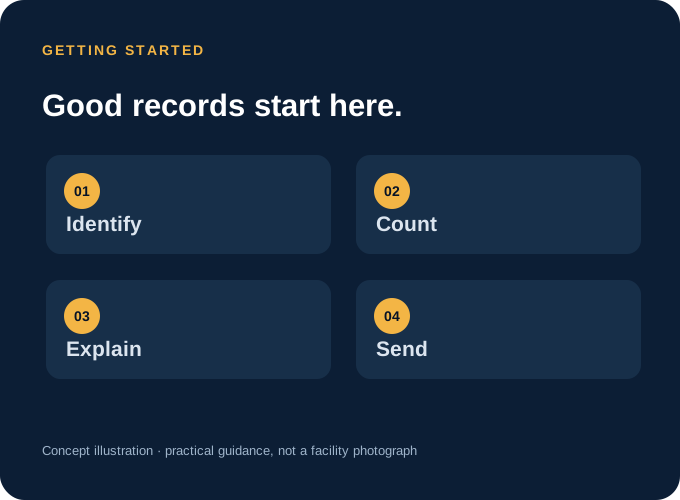
Use a consistent SKU for each product or variant. Keep the same identity on the stock list and in the order information you later supply. If two products look similar, add a useful description such as colour, size or bundle contents; avoid depending on a memory of which carton was which.
| Stock-list field | Why it helps |
|---|---|
| SKU and product name | Identifies the exact item or variant. |
| Expected units | Provides a number to check at receiving. |
| Carton reference | Helps locate units when one delivery contains several cartons. |
| Size, weight and handling notes | Explains the product profile used for setup and pricing. |
| Packing instructions | Keeps special requirements visible when orders are prepared. |
If your supplier uses a different code from the one in your store, include the relationship in your handover. One clear product identity is easier to maintain than several conflicting spreadsheets.
Make expected and received quantities easy to compare
Give the team the expected quantity for each SKU before the delivery arrives. An expected quantity is what you planned to send; a received quantity is what was actually checked in. Keeping those two numbers distinct helps reveal shortages, additional units or mixed variants.
Agree who should be contacted about differences and which evidence is useful. You may need the carton reference, a count note or a photograph. Discuss the process before delivery so the first discrepancy is handled consistently.
Organise the order handover as well as the stock
LuxFlow’s described client workflow lets you choose products and quantities and upload shipping labels through the portal. That makes product records and label files part of the practical setup. Share any agreed packing instructions alongside the order information rather than leaving them in an unrelated message.
- Check that the ordered SKU matches the inventory product.
- Supply the correct unit quantity for every line.
- Provide the shipping label required for the parcel.
- Identify any agreed insert, branding or packing requirement.
- Tell the team when instructions change.
Ask timing questions that match the work
LuxFlow’s daily dispatch slots are 10 AM and 5 PM UK local time. Agree the submission cut-off for prepared orders; stock receiving and checking arrangements remain a separate setup discussion.
Ask when your incoming stock will be checked, how exceptions are reported and when units become available for orders. For outbound work, discuss processing arrangements and courier collection separately. A collection being booked does not answer every question about the time needed to prepare stock or pack an order.
If a campaign or busy period is approaching, share the expected volume and stock arrival plan in advance. Agree the arrangements your business needs rather than assuming a general same-day promise.
Your first-delivery checklist
- Products and variants identified by SKU.
- Expected quantities and carton information supplied.
- Dimensions, weights and special handling needs discussed.
- Receiving location and arrival arrangements confirmed.
- Order submission, labels and packing instructions agreed.
- Pricing, processing and courier responsibilities understood.
- A contact route ready for discrepancies or damaged stock.
Use this list with Pick & Pack or your platform-specific service. It is also useful for established sellers switching warehouse arrangements: clear records make the new handover easier to assess.